How does the Australian Government 5% Deposit Scheme (First Home Guarantee) work?
How the First Home Guarantee lets eligible buyers purchase with a 5% deposit by guaranteeing part of the loan instead of charging LMI.


How does the Australian Government 5% Deposit Scheme (First Home Guarantee) work?
The Australian Government’s 5% Deposit Scheme — officially the Home Guarantee Scheme, and often called the First Home Guarantee — lets an eligible buyer purchase a home with as little as a 5% deposit without paying Lenders Mortgage Insurance (LMI). The government doesn’t hand over any money. Instead, Housing Australia (the scheme’s administrator) guarantees part of your home loan to your lender, which covers the gap a lender would otherwise close by requiring a bigger deposit or charging LMI. You still borrow the rest, and you still repay every dollar of it.
Lenders Mortgage Insurance (LMI) is a policy a lender takes out to protect itself — not you — when your deposit is below 20% of the property’s value. You normally pay the premium as the borrower, even though the payout (if you ever defaulted) goes to the lender.
This guide focuses on how the guarantee mechanism itself works. If you’re still weighing how large a deposit you actually need across all the available paths, see our guide to how much deposit you need for a first home in Australia.
What actually happens when the government “guarantees” your loan?
Under the scheme, your participating lender still runs its normal credit and serviceability checks and still lends you the money. What changes is what happens to the shortfall between your deposit and the 20% deposit a lender would ordinarily want before it stops requiring LMI. The government’s guarantee sits with the lender to cover that shortfall risk, which is why the lender doesn’t need to charge you LMI on the loan. The guarantee is a contingent promise between Housing Australia and the lender — it isn’t a payment to you, and it doesn’t appear anywhere in your loan account or your bank statement.
A guarantee is not a grant, a cash contribution, or a reduction in your loan amount. It’s a government undertaking to a lender that removes the lender’s usual reason for charging LMI on a low-deposit loan.
Does the guarantee reduce how much I need to borrow or repay?
No. This is the point buyers most often get wrong. The scheme doesn’t reduce your loan size, your repayments, or your interest rate — you’re still borrowing up to 95% of the purchase price (or 98% for the single parent and legal guardian cohort, covered below), and you pay principal and interest on that full amount for the life of the loan. Borrowing a larger share of the property’s value with a smaller deposit means a bigger loan balance and more interest paid over time than a buyer who put down 20% — the scheme changes who wears the LMI cost and when you can buy, not how much you owe.
Has anything about the scheme changed recently?
Since the scheme’s expansion on 1 October 2025, the Home Guarantee Scheme runs as two cohorts, not three: a 5% deposit place for first home buyers, and a 2% deposit place for single parents and legal guardians. The Regional First Home Buyer Guarantee — a separate stream that used to exist — is now closed, and the older “Family Home Guarantee” name has been retired; if you see either described as a current, live option, that source predates the restructure. As at July 2026, there are no income caps and no limits on the number of places available — both positions are confirmed current, not assumed. “Regional” still appears in the scheme, but only as a price cap tier (a higher purchase price allowed in some regional centres) — that’s a different thing from the now-closed Regional First Home Buyer Guarantee stream, and the two are easy to mix up in older articles.
The 5% Deposit Scheme is also a separate scheme from Help to Buy, a shared-equity scheme that opened later and has its own eligibility rules, including income caps that don’t apply here. The two schemes’ price caps are not interchangeable — always check which scheme a figure belongs to before relying on it, and see our guide comparing the paths to buying with a 5% deposit for how the two schemes diverge more broadly.
Who can use it, and what are the price caps?
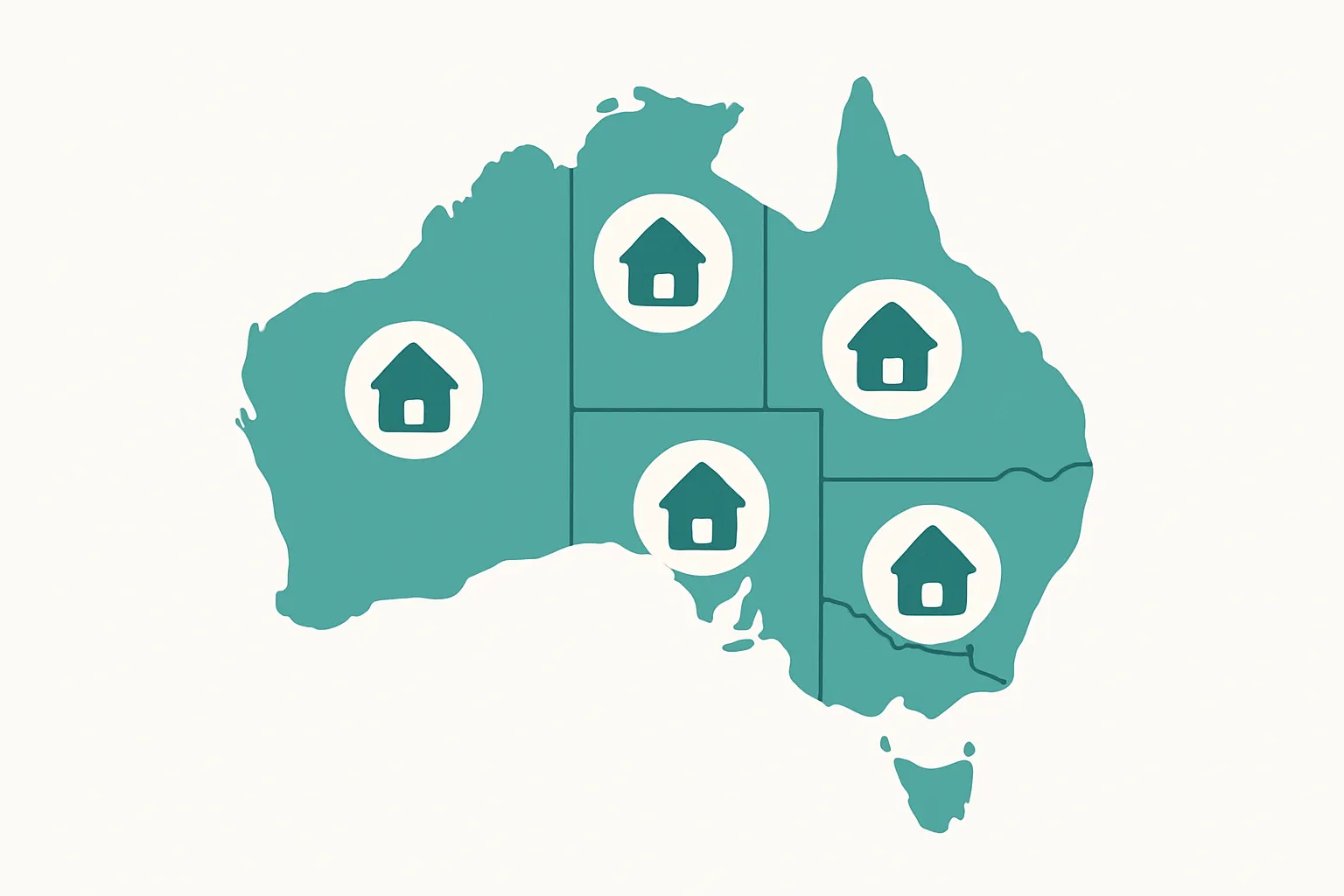
Broadly: you need to be an Australian citizen or permanent resident, at least 18, a first home buyer (or someone who hasn’t owned property in Australia in the past 10 years), buying as an owner-occupier, through a lender participating in the scheme, at or under the price cap for that property’s location. Every one of those criteria has its own detail worth reading properly — see our guide to First Home Guarantee eligibility, which also answers the income-limit question directly. Price caps vary by state, territory and whether the property is in a capital city or a regional area — see our guide to price caps by state and territory for the full table, current as at July 2026.
Is the 5% Deposit Scheme the right way to buy your first home?
That depends on your circumstances, not a rule of thumb. Buying sooner with a 5% deposit and no LMI means less time saving, but a bigger loan balance and years of extra interest compared with a buyer who saves a full 20%. Waiting to save a larger deposit reduces interest paid over the life of the loan, but delays getting into the market at today’s prices. Some buyers weigh a guarantee place against paying LMI outright, or against a family guarantee from a parent — each carries a different trade-off around risk, timing and what happens if property values move.
None of these paths is objectively “better” — which one suits you depends on your income, how quickly you want to buy, and how much of a loan balance you’re comfortable carrying. A licensed mortgage broker can model the numbers against your own situation, including which lenders currently participate in the scheme.